
Cow-brain proteins, quantum harmonies, and the surprisingly serious search for consciousness
By B.A. Crisp
You can contemplate infinity, fall in love, and wonder whether your life in this universe has a purpose. You can also walk into a room and forget why you’re there, or trip over your own two feet. Whether you are mentally soaring or physically falling, a question remains: What turns the activity inside your head into the experience of being you? Some researchers are investigating unexpected places like tiny protein structures inside your cells, and their connections to much larger electromagnetic fields and frequencies.
By now, most of us interested in consciousness studies are familiar with physicist Roger Penrose and anesthesiologist Stuart Hameroff’s theory known as, Orchestrated Objective Reduction, or Orch OR. Their proposal links coordinated quantum processes in neuronal microtubules with conscious experience. It also invokes a proposed gravity-related reduction of quantum states, a physical process they suggest could help produce moments of awareness. (pubmed.ncbi.nlm.nih.gov)
Materialists laughably, or sometimes indignantly claim, this is an ambitious assignment for a protein, which seems to prefer to finish its folding jobs and go home. But other researchers are conducting experiments that lend credence to Orch OR.
Our newest story begins, improbably, with cow brain powder. (Yes, you read that correctly.)
Cow Brains Have Entered the Chat
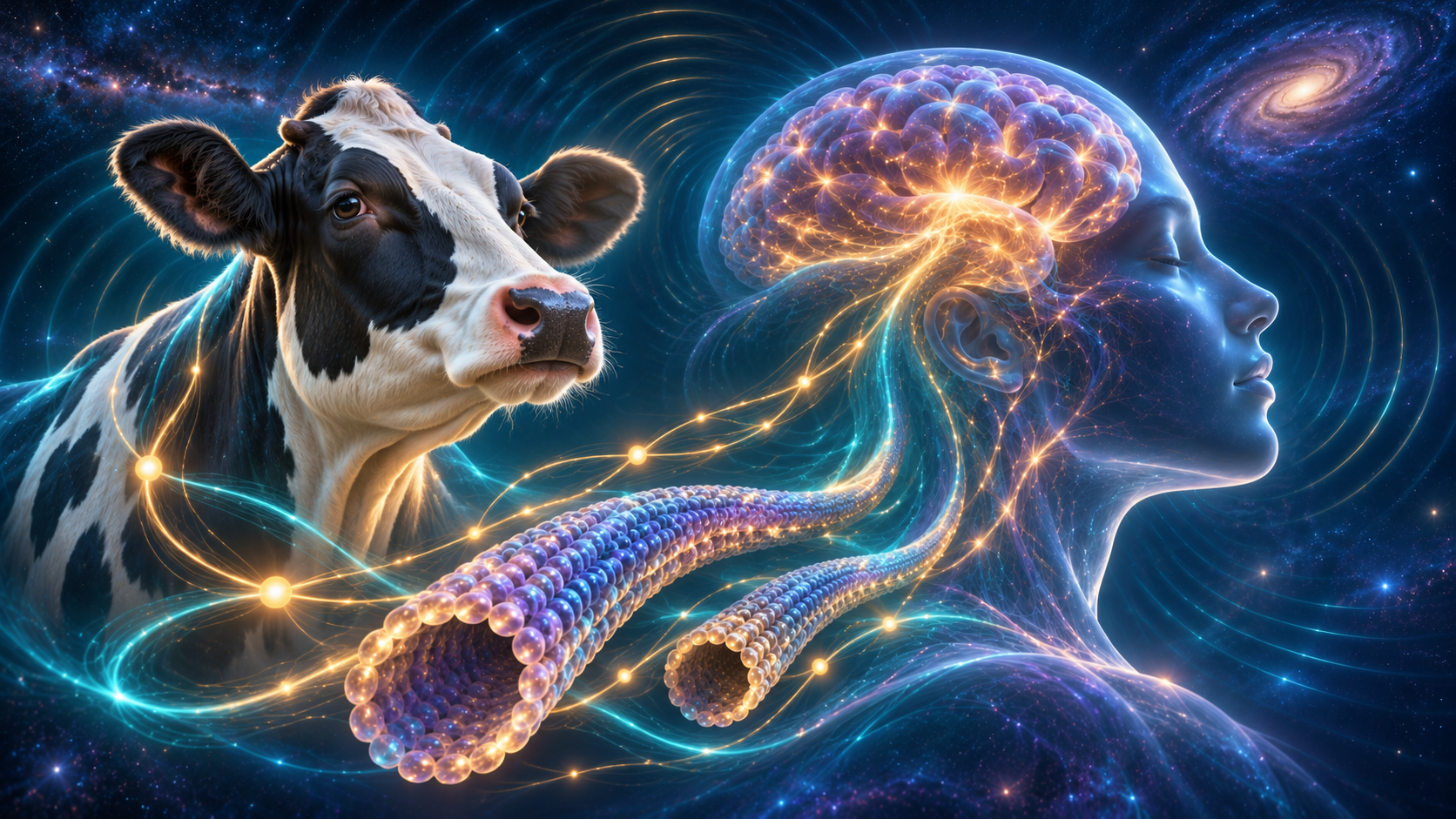
Using bovine tubulin powder for consciousness studies sounds like something out of a horror movie or a clandestine underground lab. Bovine tubulin exists, is sold for research purposes, and it is a protein obtained from cattle, usually their brains, but sometimes their hearts or other inner organs.
Tubulin molecules assemble into microtubules. Microtubules are microscopic hollow tubes that help support cells and provide “tracks" for transporting materials. Imagine a cellular railway system, with molecular motors hauling cargo without cancellations or delays.
Cow brains contain abundant tubulin, making them useful sources for controlled lab experiments. Scientists can extract the protein, assemble microtubules, and investigate their behavior. Much of this research concerns cell structure, molecular transport, and drugs and sometimes…consciousness studies. www.sciencedirect.com
Moreover, bovine tubulin is actively used to investigate how cells organize themselves, how brain-related proteins behave, and how drugs affect microtubules. It serves as a convenient laboratory building material where researchers assemble purified cow-brain tubulin into microtubules and study them under controlled conditions.
Cow Brains and Consciousness Studies
A relevant November 2025 review by Nick Mavromatos, Andreas Mershin, and Dimitri Nanopoulos explores whether microtubules could support quantum information processing. Their model emphasizes interactions between tubulin’s electrical properties and ordered water inside microtubules. They propose experiments involving spectroscopy and light–matter interactions to test those ideas.
Imagine discovering that your cells contain the makings of a microscopic starship computer. Your hollow protein tubes are where water and electricity perform a quantum dance. In this 2025 paper, researchers explore whether microtubules could serve as biological quantum processors.
Their model proposes that tubulin proteins interact with organized water inside these tubes, preserving coordinated quantum states for roughly a millionth of a second, even at body temperature. This likely sounds extraordinarily brief, but on the molecular clock it provides a very useful window for information processing. Signals travel as solitons: sturdy waves that retain their shape, like miniature couriers racing along cellular corridors without spilling their energy.
Connecting proteins act like logic gates, helping route those messages through the network.
If it works, this means that quantum computers built from biological materials can operate without elaborate refrigeration. It raises a delicious possibility that some ingredients for tomorrow’s computing revolution may already be quietly assembled inside secret labs and our cells.
Read more here about scalable quantum computing using microtubules:
When Proteins Pass the Light
In 2023, Aarat Kalra and colleagues reported that light-derived excitation energy could migrate through microtubules over approximately 6.6 nanometers. They also found that the anesthetics etomidate and isoflurane reduced that migration. (The experiment measured energy transfer, not thoughts.) ACS Publications
Think of tiny molecular neighbors passing along a burst of energy. Add an anesthetic, and the handoff becomes less effective. This is intriguing because anesthetics alter consciousness but fail to establish why someone becomes unconscious.
A separate 2024 study by Nathaniel Babcock, Philip Kurian, and colleagues examined tryptophan, a light-absorbing amino acid within tubulin. Their models predicted collective emission called superradiance, and experiments found enhanced fluorescence efficiency in assembled structures consistent with that interpretation. pubmed.ncbi.nlm.nih.gov
This is similar to imagining scattered singers around the world suddenly becoming a coordinated choir, but the choir may not know it is singing.
What does it potentially mean? It means that our microtubules could be positively or negatively tinkered with using certain frequencies for greater coherence or decoherence. We could, with uninformed manipulation, become enlightened masters of our lives…or ‘frequency-regulated’ slaves.

The Rats Who Took Longer to Tip Over
A 2024 study approached these existential questions through living animals.
Researchers at Wellesley College gave rats epothilone B, a drug that stabilizes microtubules. In the main group of eight rats, treatment delayed the loss of the righting reflex under isoflurane anesthesia. pmc.ncbi.nlm.nih.gov The righting reflex is the animal’s ability to correct its position. Losing it is a useful behavioral indicator in anesthesia research, although it is not a direct readout of subjective experience. Still, the implications are either horrifying or promising, depending on which side of the question you stand and what applications potentially arise from the research.
Dirk K. F. Meijer and Hans J. H. Geesink take the discussion even further in their 2019 paper, Life and Consciousness are Guided by a Semi-Harmonic EM Background Field. They propose that biological organization involves resonance with a background field. Their “generalized music” framework describes recurring frequency relationships resembling an adapted twelve-tone, octave-based scale. They report finding these patterns across previously published studies.
Their proposed participants include proteins, DNA, and surrounding water. Consciousness, in their model, involves interaction with a field-receptive, holographic workspace associated with the brain. Academia
“Musical” here describes mathematical relationships between frequencies. It does not mean your cells are quietly performing Beethoven or that playing a particular song will tune your consciousness…but could it?
Resonance Is Infinity Point?
Another research paper invokes Frank Wilczek discussing harmony in fundamental physics. Its subsequent account of tubulin resonance and Planck-scale connections is attributed to Penrose and Hameroff (The Planck length is roughly 1.6 × 10⁻³⁵ meters). physics.nist.gov
The proposed connection between brain proteins and that extraordinarily small Planck scale remains theoretical but interesting. Resonance provides an intriguing way to picture coordination. A swing responds strongly when you push it at the right rhythm. Musical instruments respond selectively to particular vibrations. But a resonating system does not automatically have an inner life. For example, a tuning fork can vibrate beautifully without worrying about its performance.
The scientific challenge here is to establish the missing links: Does the proposed effect occur inside living neurons? Does changing it reliably change conscious experience or awareness? Can researchers distinguish that change from ordinary effects on neuronal function? Do independent laboratories reproduce the results?
The optical studies, the anesthesia experiment, Orch OR, and Meijer and Geesink’s framework address different parts of this puzzle and juxtaposing them is intellectually productive.
Keep the Wonder. Ask the Questions.
There is something wonderfully audacious and attractive about investigating consciousness through proteins, photons, and the mathematics of harmony. Furthermore, microtubules will someday likely reveal an unexpected layer of brain function. Perhaps some quantum proposals will survive careful testing while others give way to better explanations. Either outcome could elevate or undo the human species, depending upon how such research is adapted to viable applications.
For now, we have intriguing experiments and ambitious theories—and a very large mystery between them.
If the brain really is playing along with the universe, science still has to identify the instrument, measure the signal, and explain how a performance becomes a personalized frame of reference.
Now, why did I walk into this room?
