
The Mystery of Nikola Tesla’s Missing Papers is Worth Reexamining
By B.A. Crisp
Nikola Tesla said he could stop an army, and somebody paid him $25,000 to explain how. This comes to us from an engineer’s report dated January 30, 1943.
Among Tesla’s papers, the engineer found a signed agreement with Amtorg, a Soviet trading company. Tesla acknowledged payment in 1935 for disclosing his idea. The engineer who reviewed it after his death judged the proposal unworkable.
In his 1943 review, John G. Trump, the engineer, described an agreement dated April 20, 1935, signed by Nikola Tesla and A. Bartanian of Amtorg. According to Trump’s summary, Tesla acknowledged receiving $25,000 to disclose the plans and technical information behind a proposed particle-beam system. What Amtorg bought was disclosure. The agreement establishes Soviet interest and payment.
Imagine being the person who had to tell Pentagon officials which half of that story to worry about. Read Exhibit Q, signed off by John G. Trump.
Tesla’s life helped inspire my novel X Point. I came to him through my grandfather’s stories, a few of my Uncle’s books, and Tesla’s peculiar willingness to discuss the sacred, the supernatural, and the science of electricity as if all three were closely related.
The Man Upstairs and the Power Plant Downstairs
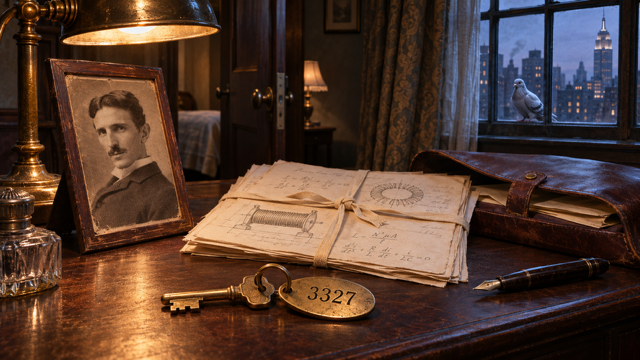
Nikola Tesla died alone on January 7, 1943, in Room 3327 of the New Yorker Hotel at the age of 86. The last associate known to have visited him a couple of days before his death was his assistant George Scherff, according to biographer Margaret Cheney. On January 4, Scherff joined Tesla at his office to help prepare an experiment. Tesla’s chest pains interrupted their work, and Tesla returned to the hotel.
In 1954, eleven years after Tesla died, Scherff’s son said he possessed some of Tesla’s writings that no government had, but his memo leaves their contents unspecified. Which papers did the assistant’s son have, and where did they go?
Interestingly, Tesla spent a decade in rooms 3327 and 3328 on the thirty-third floor of a building so advanced it had its own generating plant and a private underground passage to Penn Station. The man who helped alternating current win its place in the world spent his last few years living above a power plant that ran on Thomas Edison’s beloved direct current. The hotel’s history Physics Today on Tesla’s last night The engineering history of its power plant.
While Tesla knew fame, fortune and financial security eluded him. Westinghouse reported in 1897 that it paid $216,600 outright for Tesla’s multiphase motor patents. That’s roughly $8.4 million in 2025 buying power.
The company recorded the purchase price but how much of it landed in Tesla’s pocket is unknown. Decades later, Westinghouse paid his hotel rent and allegedly provided him $125 a month. Westinghouse’s report to shareholders Historical price index Account of the hotel arrangement.
After Tesla’s death, in September 1945, copies of selected Tesla papers went by registered mail to Wright Field in Dayton, Ohio. A month later, Brigadier General Laurence C. Craigie asked for access to what remained in a Manhattan warehouse in an alleged effort to study and re-engineer “death beam” weaponry. PBS later identified the military inquiry as Project Nick.
In November 1947, more than two years after the papers went to Wright Field, the military acknowledged it still had the reports and continued evaluating them.
Who Gets to Put a Meter on the Sky?
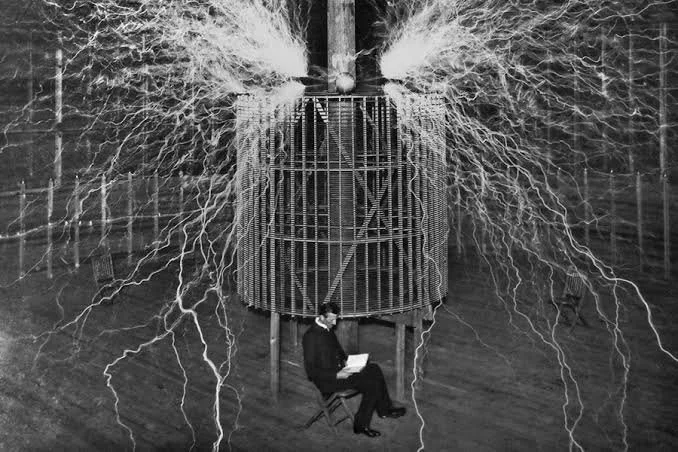
At Wardenclyffe, in Shoreham on Long Island, Tesla built a timber tower roughly 185 feet tall, crowned by an openwork dome more than sixty feet across. J.P. Morgan backed Tesla’s wireless communications venture until he realized Tesla wanted to give the world free energy.
Tesla envisioned messages, music, and pictures traveling around the globe. The unfinished tower came down for scrap in 1917. The tower and Tesla’s plans Wardenclyffe’s history and dimensions.
Today, you’re able to read this blog on a phone without wires thanks to Tesla, but eventually, you’ll have to pay someone to charge it. This well-planned global inconvenience marks the distance between Tesla’s vision and the world we currently inhabit.
Why the Office of Alien Property Went After Tesla’s Papers
In his reclusive years, Tesla approached several governments about a proposed defense weapon he called teleforce (the press preferred “death ray.”)
He claimed it could bring down 10,000 airplanes at 200 miles away, halt armies in their tracks, and wipe out military fleets. He framed the idea around preserving global peace. If world governments could make invasion unthinkable, he reasoned, a war might never begin.
The 1935 Amtorg agreement shows that this organization paid for Tesla’s information. It was a Russian company based in the U.S. and either went defunct, changed hands, or rebranded in 1998. The agreement in the examiner’s report.
Now put yourself in the shoes of Sava Kosanović, Tesla’s nephew. Your uncle has died in a hotel. His papers are scattered about New York in trunks, in a Westinghouse storage warehouse, and in a hotel safe. You arrive with your associates and require a locksmith. To a grieving family, that sounds a lot like the miserable business of protecting the contents of an estate.
But to an official reading a wartime intelligence report, the exact same visit by foreign interests, even if they are family, sounds like the beginning of an espionage case. Some U.S. officials feared Kosanović might pass Tesla’s material to adversaries. Arresting him was discussed. FBI records on the estate The account of the safe.
The Office of Alien Property Custodian took custody of Tesla’s effects. The Serbian-American inventor was a naturalized U.S. citizen, which makes the agency’s paper chase even more intriguing. Wartime correspondence shows legitimate concern over foreign access to Tesla’s papers.
While officials at the Office of Alien property likely lacked jurisdiction, they had kept Tesla under constant surveillance and swept his body and thousands of newly stamped “Top Secret” documents out of the hotel during a single operation.
The belongings went to Manhattan Warehouse and Storage, where Tesla already kept other property. Claims about additional Westinghouse caches in New York and a now defunct warehouse at a small airfield in Ohio lack a complete inventory. The receiving museum’s account The FBI’s three-part public file
About three weeks later, MIT electrical engineer John G. Trump examined material at the New York warehouse. He’d worked on Allied radar and helped develop high-voltage X-ray equipment. John Trump’s scientific work
Trump spent January 26 and 27 on the examination. He judged Tesla’s late proposals speculative and found no workable new principle of military value in the materials he reviewed. In a deposit box at another hotel, the Governor Clinton, one Tesla apparatus turned out to be ordinary electrical measuring equipment. These documents were declassified and made available to the public around 1980.
But Trump also recorded a limit to his inquiry. He left a cache of trunks that sat untouched in the New Yorker’s basement for a decade completely unexamined.
If I could go back and ask Tesla one question, it would be: what was in those trunks and what happened to them? The scope of Trump’s examination His findings on the equipment.
The Wright-Patterson General Who Wanted a Peek
In October 1945, men from a research unit at Wright Field in Dayton, Ohio, brought the FBI a letter from Brigadier General Laurence C. Craigie requesting help getting access to Tesla’s effects.
The visitors thought Tesla’s proposals and research might offer a defense against the atomic bomb. Craigie himself had been the first U.S. armed services pilot to fly a jet. Biographer Marc Seifer likened his stature to John Glenn’s. This was a man accustomed to seeing yesterday’s impossibilities lift off from runways. The 1945 request Craigie’s Air Force biography.
Later accounts attach the name Project Nick under Craigie’s purview and say most material went to what became Wright-Patterson Air Force Base.
And a couple of decades later, the United States pursued particle-beam research, including under Ronald Reagan’s Strategic Defense Initiative, nicknamed, “Star Wars.”
Seifer saw a possible thread back to Tesla and wondered whether continued military use might explain continued secrecy surrounding Tesla’s lost files. PBS on the missing papers White House Science Council assessment.
One FBI memo recounts a conversation with an adviser to Vice President Henry Wallace about preserving Tesla’s effects amid concern over wireless power, proposed weaponry, and free energy.
In the five-part HISTORY series The Tesla Files, Seifer, author of Wizard: The Life and Times of Nikola Tesla, joined astrophysicist Travis Taylor and investigator Jason Stapleton. They followed the story from Colorado Springs to the New Yorker and Wardenclyffe, then to California and Silicon Valley.
They explored how Vannevar Bush may have played a part in secreting Tesla’s files and whether FDR sought a meeting with Tesla before he died. Bush headed the Office of Scientific Research and Development while general Leslie Groves directed the Manhattan Project. The proposed Roosevelt meeting remains an open question. The Wallace memo Sarah Pruitt’s reporting and interview with Seifer National Park Service on Bush.
Similarly, biographer Margaret Cheney reported that a military-intelligence letter from Colonel Ralph Doty, asked where Tesla’s files were and who else was seeking access. His letter was declassified on May 8, 1980. The fate of the Wright-Patterson copies of Tesla’s allegedly classified papers is another mystery.
In 1947, the military acknowledged it still had Tesla’s missing papers. Then, in a 1980 response quoted by Cheney, the Air Force said a search of its retired-records lists found no mention of them and that it inferred they were destroyed when the WPAFB laboratory closed. That leaves their final disposition uncertain.
Eighty Trunks, Sixty Packages, and One Piece of Bad Math That Fails to Add Up
The FBI made roughly 250 pages of Tesla-related records public in a 2016 Freedom of Information Act release, followed by two more releases through March 2018. These are government records about Tesla. His scientific papers have an archive of their own, and it’s in Belgrade. FBI Vault Release history.
The Nikola Tesla Museum dates the American court’s grant of custody to January 1943. In September 1951, the ship Serbia delivered Tesla’s estate to the port of Rijeka. From there it went by rail to Belgrade. In 1952, the collection moved into a villa that eventually became the Tesla Museum. The museum’s shipping and custody history.
And here’s where the famous missing-trunks calculation raises eyebrows. An early report estimated about eighty trunks in various places. But the museum records sixty packages in the shipment, including suitcases, metal trunks, and barrels. Subtract sixty from eighty and you get twenty.
Twenty missing trunks make a terrific headline. To print it, somebody must show that a barrel arriving in 1951 corresponds to a trunk counted in 1943.
Seifer intelligently allowed for repacking and raised the intriguing possibility that the U.S. government retained a lot of Tesla’s material. Neither those counts nor the FBI releases substantiate 7,000 missing/classified Tesla files. The early report The museum’s inventory description.
I went looking for what vanished. The museum catalogs Tesla’s personal archive under 163,911 call numbers. It holds calculations and diagrams, certainly, but also business cards, canceled stamps, checks, and notes in pencil. Think of the ordinary scraps a family clears out after someone dies. In Tesla’s case, somebody saved his pencil marks. Inside the Nikola Tesla Museum archive.
Which of Tesla’s ideas made other people wealthy?
There’s a working theory that the Department of Energy shared classified Tesla research with private companies and that GPS and smartphones were only a small part of what emerged into the public domain after special unacknowledged access programs moved on from them.
For example, Westinghouse, the company that helped pay Tesla’s rent, later helped build America’s nuclear Navy and develop civilian nuclear power at Shippingport.
In France, Framatome licensed Westinghouse reactor technology for a program associated with the utility Électricité de France.
In America, the old Westinghouse corporation became CBS and merged with Viacom after the nuclear business was sold.
Cameco and Brookfield completed their acquisition of the nuclear company in 2023.
Each is a genuine tie among industry, media, and government even if a single Tesla notebook or the missing 7,000 pages can’t be directly traced.
And GPS has its own documented history in military satellite navigation that might interest you: Naval Nuclear Laboratory French parliamentary history · Westinghouse’s account of the corporate split Cameco NASA’s GPS history.
For a piece of the future we now occupy, something can also be traced directly to Tesla. In 1898, he modified a model boat in Madison Square Garden. Then he sent it a wireless command. The boat remotely moved around without human hands touching the rudder. Here, Seifer sees the beginnings of radio guidance, remote-controlled robots, secure signaling and vast numbers of wireless channels in Tesla’s work.
Today’s encryption and wireless communications have many inventors. But when you press a button in 1898 and a toy boat obeys, that boat is a perfectly good precursor for wireless energy. See the museum’s model of Tesla’s boat.
Could Tesla’s Glowing Tubes and X-Rays Teach Us About Quantum Physics?
Yes, because a connection exists when we look at what happened inside his tubes, rather than at the equipment that powered them. In his early-1890s lectures, Tesla demonstrated how electrical energy could make gas in partially evacuated glass tubes glow. Imagine watching a sealed tube light up back then. Why does the gas give off those colors?
Quantum mechanics supplies an answer Tesla did not yet have. Electrical excitation raises an atom to a higher energy state. When it drops to a lower one, it releases a packet of light called a photon. The allowed energy levels are like the rungs of a ladder. The atom cannot arbitrarily settle anywhere between them. Each transition produces a photon whose energy matches the difference between those levels. Viewed through a spectroscope, the gas’s light separates into distinct lines, which is a signature of its atomic structure. The glow alone is not proof of quantization, but those specific wavelengths reveal something interesting. For the historical experiments, see Tesla’s lectures and electrical research.
Tesla’s X-ray experiments offer another window into the same world. In 1896, he used a vacuum tube of his own design to produce images he called “shadowgraphs,” including an image of a foot inside a shoe. Here was radiation the eye could not see, recording structures hidden beneath the surface.
Tesla explored ways of making matter emit light and invisible radiation. Quantum mechanics later explained the photons and allowed energy levels behind those phenomena. Modern researchers have gone further, engineering superconducting circuits that exhibit distinct energy levels and quantum tunneling—the ability to cross an energy barrier that classical physics would forbid with the energy available.
John Clarke, Michel Devoret, and John Martinis shared the 2025 Nobel Prize in Physics for experiments demonstrating those effects. Today, engineered circuits with distinct energy levels serve as superconducting qubits, units of quantum information. The Nobel committee’s account How superconducting circuits become qubits.
Did Tesla Leave Us a Path to Cold Fusion?
If we open the January 1930 issue of Physical Review, three Carnegie Institution researchers reported using Tesla coils to produce and measure extraordinarily high voltages. The researchers considered whether those voltages could accelerate helium nuclei for experiments.
Merle Tuve’s research archive even lists the apparatus by name, the Tesla coil accelerator. Here, at last, is an actual paper trail from Tesla’s workbench to scientists studying the atom: The 1930 paper Tuve’s records at the American Institute of Physics.
Moreover, fusion happens when light atomic nuclei join. Because positively charged nuclei repel one another, getting them close is hard. Electric fields give charged particles energy, and quantum tunneling gives closely approaching nuclei a chance to fuse. A cool piece of laboratory equipment can therefore host a fusion event if an external source supplies energetic particles: How tunneling figures in fusion.
An extraordinary claim called cold fusion came in 1989, when Martin Fleischmann and Stanley Pons attributed excess heat from an electrochemical cell to nuclear fusion. Later, a multi-institution team revisited the subject and reported in Nature in 2019 that it had found no evidence of the claimed effect in the conditions it tested. But the researchers did find worthwhile questions about the behavior of hydrogen inside metals. One of those questions has since paid off: The 2019 Nature study.
In 2025, researchers reported that a palladium target holding additional deuterium, a heavy form of hydrogen, produced about fifteen percent more fusion events when struck by externally energized deuterium ions. Within this research comes a number I circled in the margin.
The team put the power equivalent of the measured neutron output at about one billionth of a watt, against fifteen watts of input. The experiment showed that the material hosting a reaction affected how frequently it happens. A power source would have to return more energy than the system consumes.There’s an immense distance between those achievements, and this team gave us a way to measure it:The 2025 experiment in Nature.
So, what did Tesla contribute? A way to generate high voltages that other researchers later picked up and tested. A Tesla design for a working cold-fusion generator still lacks one thing his radio-controlled boat had in 1898. A public audience granted access to watch it work.
I began this story wanting a look inside Tesla’s missing papers. After the secret contracts, the official letters, and the faulty arithmetic, I keep coming back to his window.
The man in hotel room 3327 once imagined sending a greeting to otherworldly beings and even claimed he intercepted messages from Venus. In his later years, he kept company with a pigeon he claimed to love. It’s a damn near perfect discredit campaign where he was labeled crazy. If so, why even bother confiscating and classifying his work?
Tesla’s life offered me an intriguing question, which helped me write X Point:
When someone reports an unidentified encounter that the majority of us can’t explain, what do we owe them?
In fiction, I get to open the door and let you see for yourself: Step inside X Point, Book II of the Quanta Chronicles.
If you had an hour with Tesla and he had to answer one question honestly, what would you ask him?
